 B2B Data Strategies
 Aug 31, 2026
5 min read
Aug 31, 2026
5 min read
Learn the common mistakes businesses make when buying an Event Planner Database and how to choose accurate, verified data for better sales.
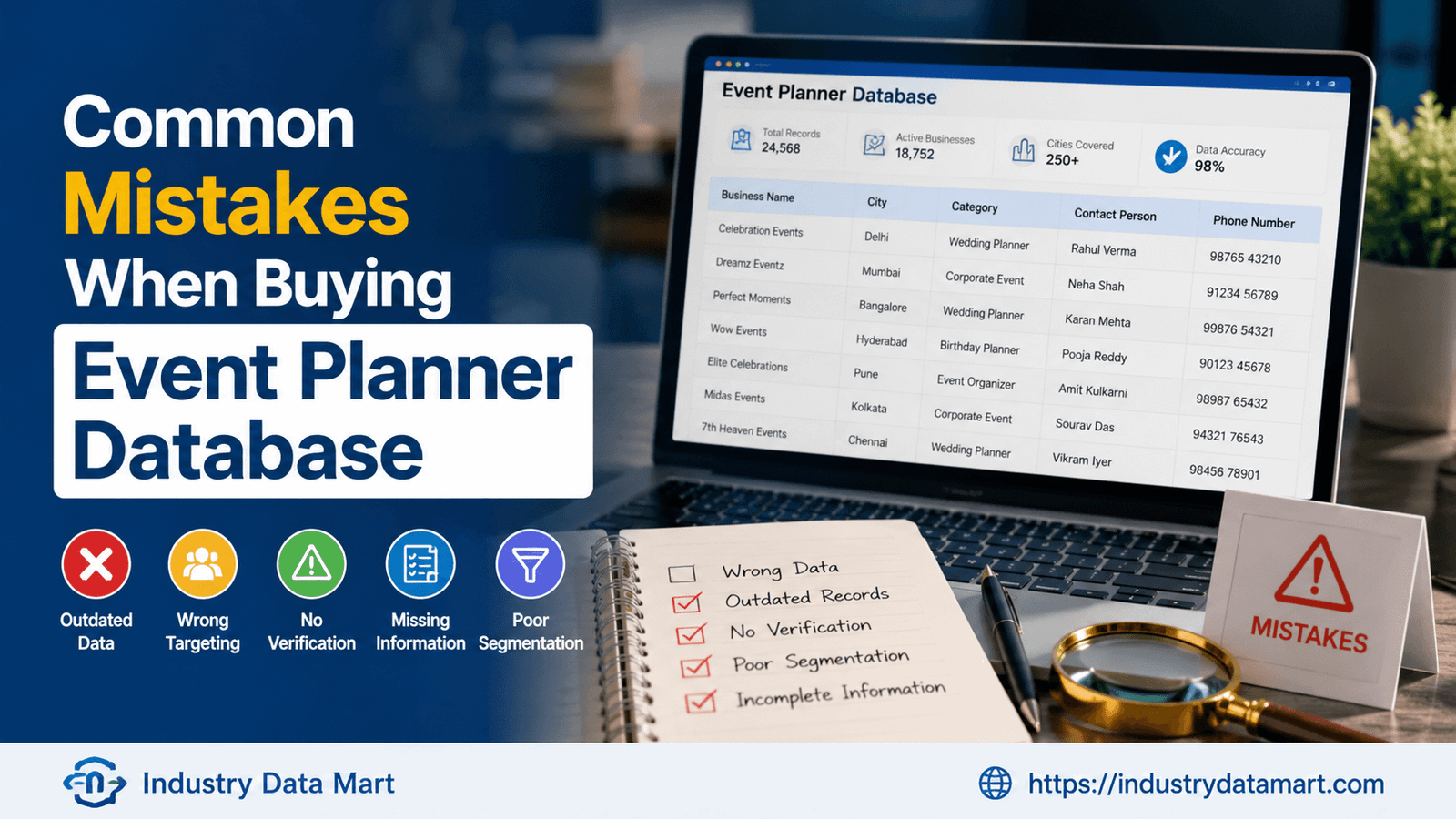
Buying an Event Planner Database can be a practical way for businesses to identify potential customers, suppliers, partners, and sales opportunities in the growing events industry. However, purchasing data without checking its quality can lead to wasted money, poor conversions, and unnecessary compliance concerns. At Industry Data Mart, we believe businesses should evaluate data carefully before making a purchase. A reliable Event Planner Database should help your sales team reach relevant businesses rather than simply provide a large spreadsheet of names and numbers.
Many business owners focus only on the number of records included in an Event Planner Database. In my experience, as a CA advising businesses on commercial decisions, the better question is: “How useful is this data for my actual business objective?” Accuracy, relevance, freshness, segmentation, and responsible usage are often much more important than volume.
One of the biggest mistakes is assuming that a larger Event Planner Database automatically provides better value.
For example, suppose one provider offers 100,000 records while another offers 25,000 carefully segmented event planning businesses. If the larger database contains outdated numbers, irrelevant businesses, duplicates, or unrelated companies, the smaller database may generate considerably better results.
Before purchasing an Event Planner Database, ask what makes the records relevant to your target market. Quality should always come before quantity.
An Event Planner Database is useful only when its information is reasonably accurate and usable.
Business contact details can change because companies relocate, change numbers, close operations, or update their business structure. Using old information can result in wasted sales calls and additional administrative work.
Before buying, ask the provider:
These questions can help you distinguish a professionally prepared database from a simple collection of publicly available information.
Not every record should be treated as a sales-ready prospect. A basic Event Planner Contact List may contain names and numbers, but that does not necessarily mean every business is currently active or relevant.
Businesses should understand what “verified” means before purchasing Event Planner Verified Leads. Verification should have a clear methodology rather than being used simply as a marketing term.
If your objective is lead generation, ask whether records are checked for business relevance and whether obvious duplicates and inactive entries are removed.
Another common mistake is purchasing an Event Planner Database before deciding exactly whom you want to target.
An event-related business could include wedding planners, corporate event organisers, exhibition organisers, party planners, conference organisers, decorators, and other service providers.
If your company sells accounting software, for example, your ideal prospect may be an established event management company rather than every individual associated with the events industry.
Define your target customer first. Then select an Event Planner Database that matches your requirements.
Location can make a significant difference to sales performance.
A company operating in Delhi may not receive much value from an unsegmented nationwide Event Planner Business Database India if its sales team can only serve businesses within a limited geographical area.
Ask whether the Event Planner Database can be organised by state, city, or other relevant business categories. Geographic targeting can help sales teams prioritise prospects and reduce unnecessary outreach.
The cheapest Event Planner Database is not necessarily the most economical choice.
Consider the total cost of using poor-quality information. Your employees may spend hours calling incorrect numbers, researching irrelevant businesses, and updating records. This creates an indirect cost that is often much higher than the original database price.
A sensible purchasing decision should compare expected business value, data quality, usability, segmentation, and support—not just the quoted price.
Before purchasing an Event Planner Database, ask whether the provider can demonstrate the type and structure of the data.
A sample can help you understand whether the information matches your expectations. Look at the fields, formatting, business categories, geographical coverage, and overall relevance.
A transparent provider should be able to explain what customers are receiving without making unrealistic promises.
Even accurate information can become difficult to use if the database is poorly formatted.
Your sales team may need data that can be organised and filtered efficiently. Before purchasing an Event Planner Database, check whether the supplied format works with your existing workflow.
Poor formatting, inconsistent phone numbers, missing fields, and duplicate entries can create unnecessary manual work.
This is perhaps the most important commercial mistake.
An Event Planner Database is a prospecting resource, not a guarantee of sales. Even highly relevant Event Planner Verified Leads may not immediately become customers.
Conversion depends on several factors, including your product, pricing, sales approach, timing, customer need, and follow-up process.
The right approach is to measure the database as part of your overall sales process rather than expecting every record to produce revenue.
Before making your final purchase, follow these practical steps:
A properly selected Event Planner Database can support sales planning, market research, territory development, partnership identification, and business expansion. But its usefulness depends heavily on how carefully the database is selected and how responsibly it is used.
From a business perspective, data should be treated as an investment rather than simply a downloadable file. The objective should be to obtain relevant information that helps your team make better commercial decisions.
At Industry Data Mart, we recommend checking the source, quality, relevance, segmentation, and intended use before purchasing any Event Planner Database. Taking these precautions can help businesses reduce wasted effort and improve the efficiency of their prospecting activities.
An Event Planner Database is a structured collection of business information related to event planning companies and professionals. Depending on the provider and product, it may include business names, contact details, locations, categories, and other relevant business information.
An Event Planner Database can help businesses identify potential prospects, understand market coverage, build targeted sales lists, and develop regional business opportunities. Its effectiveness depends on data quality and how well the records match the company's ideal customer profile.
Check the freshness, accuracy, geographical coverage, business categories, duplicate handling, data format, and verification methodology. You should also understand how the information is intended to be used and ensure your outreach practices comply with applicable requirements.
No. Verified leads can improve the quality of prospecting, but they cannot guarantee sales. Conversion depends on your offering, pricing, sales process, follow-up, timing, and the prospect's actual business requirements.
Not necessarily. A smaller, relevant, and better-maintained database can be more valuable than a very large collection containing outdated or irrelevant records. Businesses should prioritise quality and relevance over record count.
Buying an Event Planner Database should be a business decision based on quality, relevance, accuracy, and expected value—not simply the number of records offered. Avoiding common mistakes such as ignoring data freshness, skipping sample checks, overlooking segmentation, and choosing purely on price can help you make a more informed purchase.
If you are looking for business data to support your prospecting and market expansion strategy, Industry Data Mart can help you evaluate the right data requirements for your business. Choose your Event Planner Database carefully, use the information responsibly, and turn better data into more focused business opportunities.

Lorem ipsum dolor sit amet consectetur. Nec nunc pellentesque massa pretium. Quam sapien nec venenatis vivamus sed cras faucibus.