 Healthcare Industry Data
 Sep 25, 2026
8 min read
Sep 25, 2026
8 min read
Learn how to verify a Cardiologist Clinic Contact Database using practical checks for accuracy, freshness, duplicates, phone numbers, emails, and compliance.
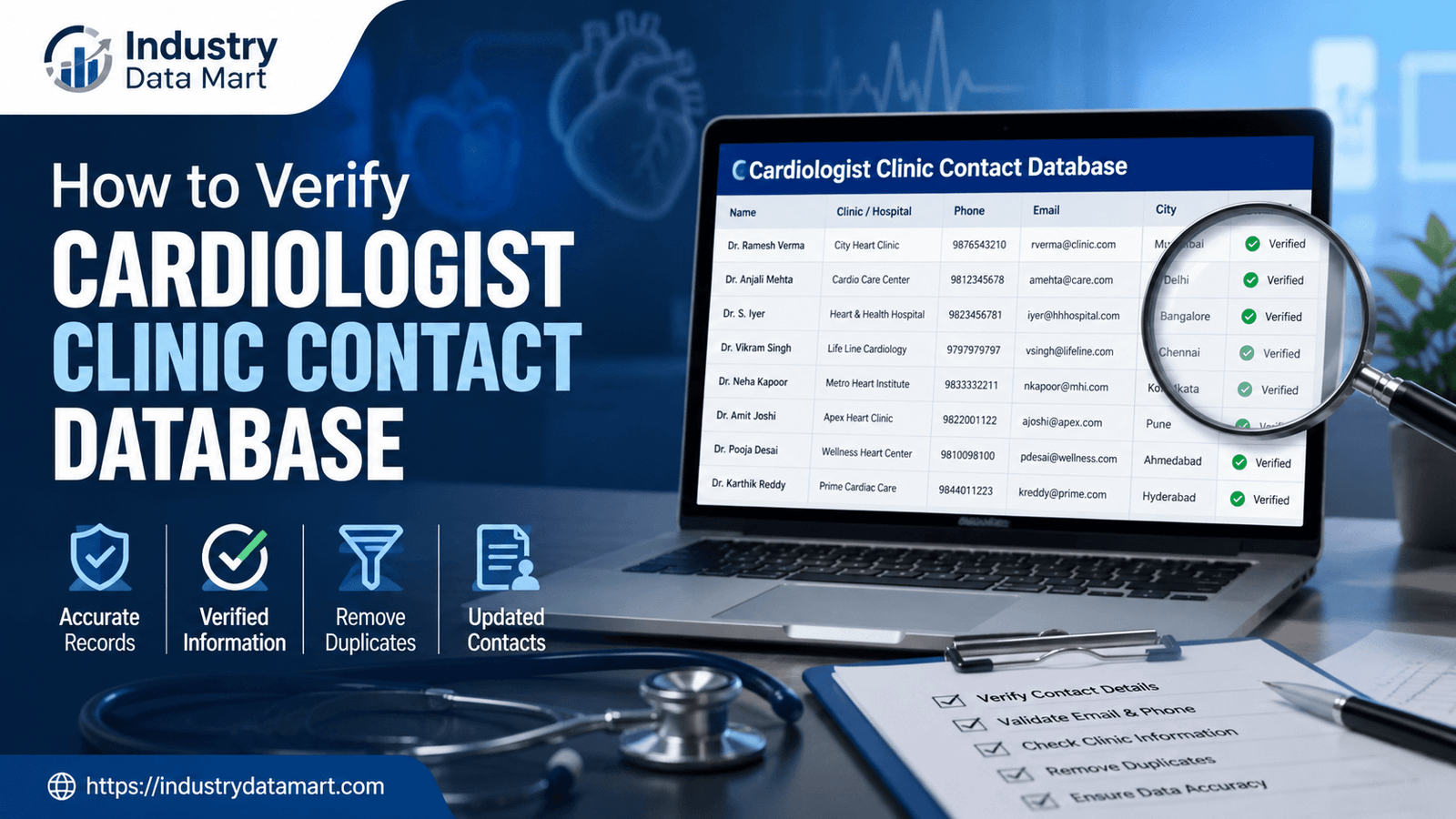
A reliable Cardiologist Clinic Contact Database can be a valuable business asset for healthcare marketers, medical suppliers, recruitment agencies, research companies, and B2B service providers. However, having thousands of records does not automatically mean you have a useful database. Outdated phone numbers, incorrect clinic names, duplicate records, and inactive practitioners can quickly reduce campaign performance. At Industry Data Mart, we recommend treating database verification as a regular business process rather than a one-time exercise. If you are looking for a professionally structured Cardiologist Database, verification should always be an important part of your evaluation.
Imagine a medical equipment company purchasing a list of 10,000 cardiology contacts. After starting its campaign, the team discovers that 15% of phone numbers are unreachable, several doctors have moved clinics, and hundreds of records belong to the same practice.
The problem is not necessarily the size of the database. It is the quality.
A properly verified Cardiologist Clinic Contact Database can help businesses:
For businesses seeking Verified Cardiologist Leads India, verification is especially important because healthcare professionals may work across hospitals, private clinics, diagnostic centres, and multiple locations.
Verification should follow a systematic process. Simply checking whether a phone number appears to be valid is not enough.
Start by confirming that each individual is actually a cardiologist.
Review important information such as:
This step helps eliminate irrelevant healthcare professionals and prevents a Cardiologist Database from becoming a generic medical contact list.
A cardiologist's workplace can change over time. Therefore, compare clinic information with credible and current sources.
Check whether:
For a Cardiologist Clinic Contact Database, business location is particularly important because one doctor may have consulting hours at multiple facilities.
Phone verification is one of the most practical steps in database cleaning.
Look for:
Do not assume that every number attached to a doctor is a direct professional contact. A responsible database should clearly distinguish between clinic contact details and other information.
Email verification is equally important for digital campaigns.
A good verification process should identify:
For marketing teams, a clean email field can make a significant difference to campaign deliverability.
One of the strongest ways to verify a Cardiologist Clinic Contact Database is to compare information across multiple reliable sources.
For example, suppose your Cardiologist Contact Details List says that Dr. A is consulting at Clinic X in Delhi. Instead of accepting the record immediately, compare the information against current clinic information, hospital listings, professional profiles, and other credible sources where available.
If several sources agree, confidence in the record increases.
If the information conflicts, flag the record for manual review rather than treating it as verified.
Duplicates are a common problem in healthcare databases.
A single cardiologist might appear several times because they:
For example, “Dr. Rajesh Kumar,” “Dr Rajesh Kumar,” and “Rajesh Kumar, MD” could potentially represent the same professional.
Before removing duplicates, compare multiple fields such as name, location, clinic, phone number, and email address. This prevents genuine separate records from being incorrectly merged.
A Cardiologist Clinic Contact Database should have a defined freshness standard.
Contact information can change because doctors relocate, clinics close, hospitals restructure departments, and telephone numbers are reassigned. Even an accurate database can gradually become outdated.
A practical verification cycle may include:
The frequency should depend on how the database is being used and how quickly the underlying information changes.
Quality is not only about accuracy. The structure of the Cardiologist Clinic Contact Database also matters.
Depending on your legitimate business requirement, useful fields may include:
A well-organised Cardiologist Database makes segmentation and campaign management easier.
For instance, a medical-device company may want to segment cardiologists by city, while a healthcare recruitment firm may require hospital affiliation and professional designation.
Businesses handling large databases can introduce a simple verification score.
For example:
High confidence: Name, clinic, location, phone, and professional affiliation have been cross-checked.
Medium confidence: Most details appear accurate, but one field requires confirmation.
Low confidence: Several fields are outdated, missing, or inconsistent.
This approach helps sales and marketing teams prioritise their efforts. Rather than treating every record in a Cardiologist Clinic Contact Database as equally reliable, teams can focus first on high-confidence contacts.
Healthcare contact information should be handled responsibly. Businesses should consider applicable privacy, marketing, data-protection, and telecommunications requirements before collecting, storing, or contacting professionals.
A database should be used for legitimate business purposes, with appropriate controls around access, storage, retention, and communication.
Avoid relying on information that appears private or unrelated to professional activity. A professional Cardiologist Contact Details List should focus on appropriate business contact information rather than unnecessary personal data.
When evaluating a Cardiologist Clinic Contact Database, avoid these common mistakes:
A smaller, well-verified database can often be more useful than a massive collection of questionable records.
It is a structured collection of professional contact and business information relating to cardiologists and their clinics, hospitals, or healthcare organisations.
There is no universal interval. Businesses should establish a verification schedule based on how frequently their target information changes and how important current contactability is to their campaigns.
Accuracy, freshness, completeness, minimal duplication, appropriate sourcing, and consistent verification are key indicators of database quality.
They can be useful when the information is accurate, professionally relevant, appropriately sourced, and used in accordance with applicable laws and communication requirements.
No. Verification should be based on evidence and defined quality criteria. Records with uncertain or conflicting information should be flagged for review.
A Cardiologist Clinic Contact Database is only as valuable as the accuracy of the information inside it. From checking professional identities and clinic affiliations to validating phone numbers, emails, locations, and duplicates, every verification step contributes to better data quality.
At Industry Data Mart, we believe businesses should focus on usable, relevant, and regularly reviewed data rather than simply chasing large contact volumes. Whether your objective is healthcare marketing, B2B outreach, market research, or business development, a properly evaluated Cardiologist Clinic Contact Database can provide a stronger foundation for your campaigns.

Lorem ipsum dolor sit amet consectetur. Nec nunc pellentesque massa pretium. Quam sapien nec venenatis vivamus sed cras faucibus.