 B2B Data Strategies
 Sep 04, 2026
6 min read
Sep 04, 2026
6 min read
Learn how to choose an Event Planner Database for business growth, verified leads, better targeting, sales planning, and higher conversion.
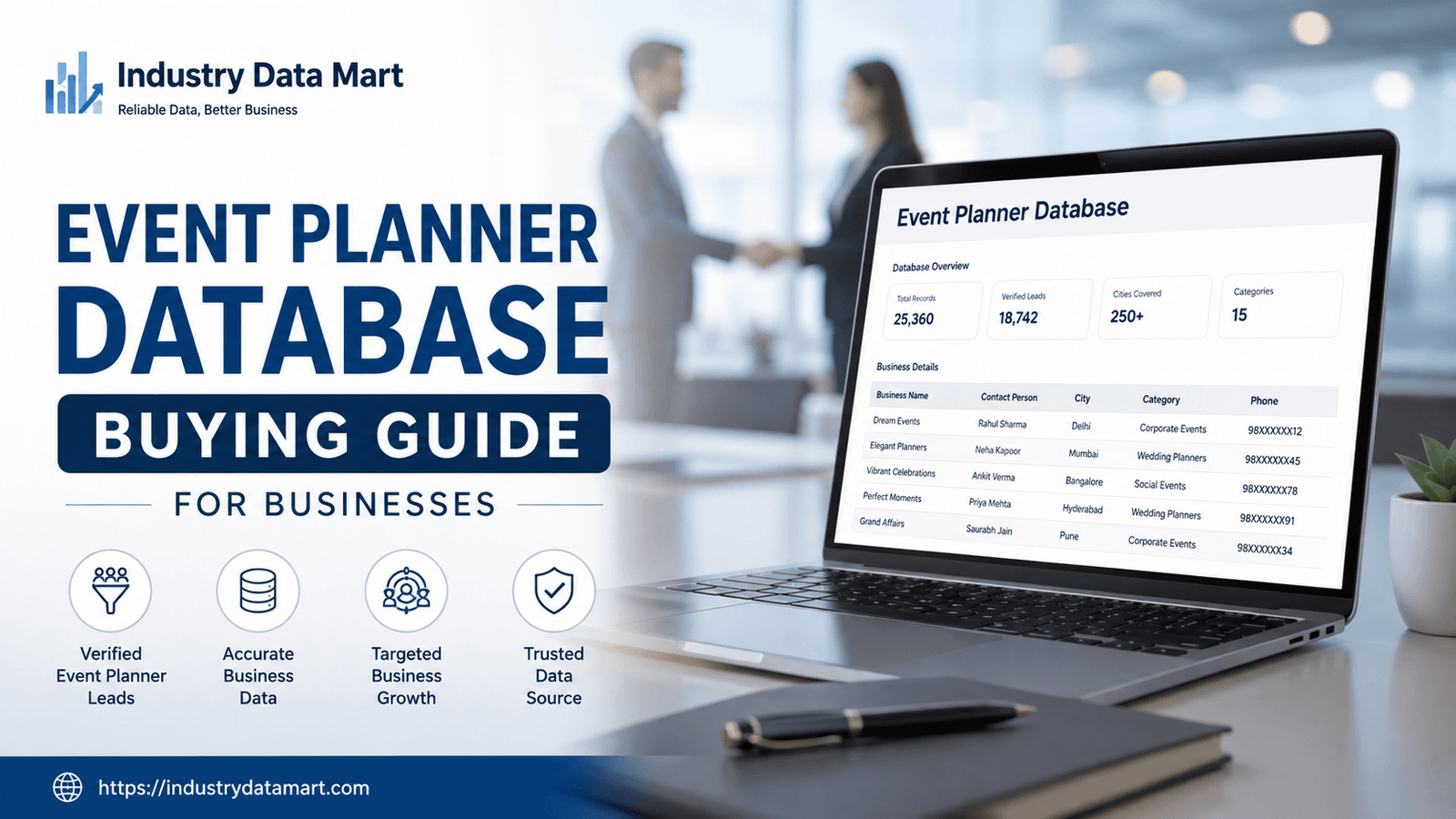
Buying the right Event Planner Database can make a major difference for businesses that sell products or services to event planners. Whether you provide event supplies, venue services, catering, decorations, technology, printing, transportation, financial services, or professional solutions, reaching the right decision-makers is often more important than simply reaching a large audience.
For businesses looking to identify genuine prospects, an Event Planner Database can provide a structured starting point for sales and business development. However, not every database offers the same quality. From our experience at Industry Data Mart, businesses should evaluate data accuracy, relevance, coverage, verification, usability, and compliance before making a purchase.
A good database is not just a collection of names and contact details. It should help your sales team identify suitable prospects, understand the market, organise outreach, and build a practical lead-generation strategy.
An Event Planner Database is a structured collection of business information relating to event planners and event management professionals. Depending on the provider, the information may include business names, contact details, locations, business categories, and other relevant information.
For example, a company selling professional lighting equipment may want to identify event planners operating in Delhi, Mumbai, Bengaluru, Hyderabad, or other major business centres. Instead of searching for prospects individually, a well-organised database can make the research process considerably faster.
The important point is that businesses should focus on usable and relevant data, rather than simply choosing a database based on its size.
Event planners regularly work with multiple vendors and service providers. This makes them a valuable target audience for businesses operating in the event, hospitality, technology, printing, transportation, finance, and professional services sectors.
A properly selected database can help businesses:
For instance, a company supplying customised event merchandise may have better results by approaching event planners directly rather than advertising to a broad consumer audience.
When purchasing an Event Planner Business Database India, businesses should look beyond the number of records advertised. A smaller, relevant and properly maintained dataset can be more valuable than a very large database containing outdated or unsuitable records.
Accuracy should be your first consideration. Incorrect business names, disconnected contact details, duplicate records, or outdated information can waste valuable sales time.
Ask the provider how the information is collected, reviewed, and updated. A professional data provider should have a clear approach to data quality.
Before purchasing, check exactly what information is included. Useful fields may include:
The fields you need depend on your sales strategy. A local service provider may primarily need location and business contact information, while a national supplier may require broader geographic coverage.
Verification is particularly important when the database will be used by a sales team. Event Planner Verified Leads can help reduce the number of irrelevant prospects and improve the efficiency of sales activity.
However, businesses should ask what “verified” actually means. Does verification involve checking the business details, reviewing contact information, removing duplicates, or confirming activity? Understanding the verification process helps you judge the actual quality of the database.
Geographic targeting can significantly influence campaign performance.
Suppose a company operates only in Uttar Pradesh. Purchasing a database dominated by businesses from states where the company does not provide services may not offer much commercial value.
Before buying, identify the cities, states, or regions that matter to your business. Then confirm whether the database provides adequate coverage in those locations.
Choosing an Event Planner Sales Leads Database should be treated as a business decision rather than simply a marketing purchase.
First, decide who you want to approach.
Are you targeting independent event planners, event management agencies, wedding planners, corporate event organisers, exhibition organisers, or businesses handling multiple event categories?
A clear customer profile makes database selection easier.
Determine whether your sales team needs national, state-level, or city-level coverage.
For example, a business serving only North India should prioritise relevant regions instead of paying for unnecessary nationwide information.
Ask providers about duplicate removal, data verification, update frequency, and the source of information.
Do not assume that a larger record count automatically means better value.
The database should be delivered in a format your team can actually use. A clean and organised spreadsheet or compatible data format can make filtering, sorting, assigning leads, and tracking sales activity much easier.
Think about how your team will use the information after purchasing it.
For example, you could divide prospects by city and assign each group to a sales representative. Another approach is to segment prospects by business type and create different sales pitches for each category.
Many businesses make the mistake of focusing only on price or record volume. This can result in poor-quality leads and unnecessary expenditure.
Avoid these common mistakes:
Choosing only on database size: Thousands of irrelevant records do not necessarily create business value.
Ignoring duplicate records: Duplicate entries can cause sales representatives to contact the same prospect repeatedly.
Failing to check geography: Data outside your service area may have little commercial value.
Not understanding verification: Always ask how the provider defines and performs verification.
Buying without a sales plan: Even good data requires proper segmentation, follow-up, and sales execution.
Ignoring data responsibility: Businesses should use business information responsibly and follow applicable laws, regulations, and communication requirements.
Purchasing data is only the first step. The real value comes from how effectively your business uses it.
Start by segmenting prospects based on location, business type, potential requirements, and sales priority. Create a clear communication strategy instead of sending the same sales pitch to everyone.
For example, an event technology company could approach corporate event planners with a message focused on conference solutions, while a wedding supplier could focus on planners handling weddings and social events.
Your sales team should also maintain a follow-up system. Record which prospects have been contacted, which ones showed interest, which require follow-up, and which are not suitable. This turns a static database into a practical sales pipeline.
An Event Planner Database is a structured collection of business information related to event planners and event management businesses. It can help companies identify relevant prospects, organise sales activities, target specific locations, and develop B2B business opportunities.
Yes. Small businesses can use targeted business data to reduce manual prospect research and focus their limited sales resources on relevant potential customers. The key is selecting data that matches their target industry, geography, and ideal customer profile.
Review the available data fields, geographic coverage, duplicate removal process, verification methodology, update practices, and database format. You should also understand what the provider means by verified or validated information.
No. Database quality is generally more important than database size. A relevant dataset containing accurate and usable prospects can deliver more commercial value than a much larger collection containing duplicates or outdated information.
Businesses should segment prospects, create relevant sales messages, assign leads to sales representatives, maintain follow-up records, and regularly measure conversion results. A structured sales process helps turn business data into genuine opportunities.
A quality Event Planner Database can become a useful resource for businesses looking to expand their B2B sales pipeline and reach event professionals more efficiently. But the right purchase requires more than comparing record counts and prices.
At Industry Data Mart, our approach is to help businesses focus on relevant business information, practical targeting, data quality, and sales usability. Before purchasing any database, clearly define your target customer, geography, required fields, and sales objectives.
If your business is looking to connect with event planners and develop new B2B opportunities, explore the available Event Planner Database solutions from Industry Data Mart and build your prospecting strategy around relevant, organised business data.

Lorem ipsum dolor sit amet consectetur. Nec nunc pellentesque massa pretium. Quam sapien nec venenatis vivamus sed cras faucibus.