 B2B Data Strategies
 Aug 19, 2026
8 min read
Aug 19, 2026
8 min read
Compare Event Planner Database with manual lead collection and learn how verified event planner contacts can improve sales, marketing, and business growth.
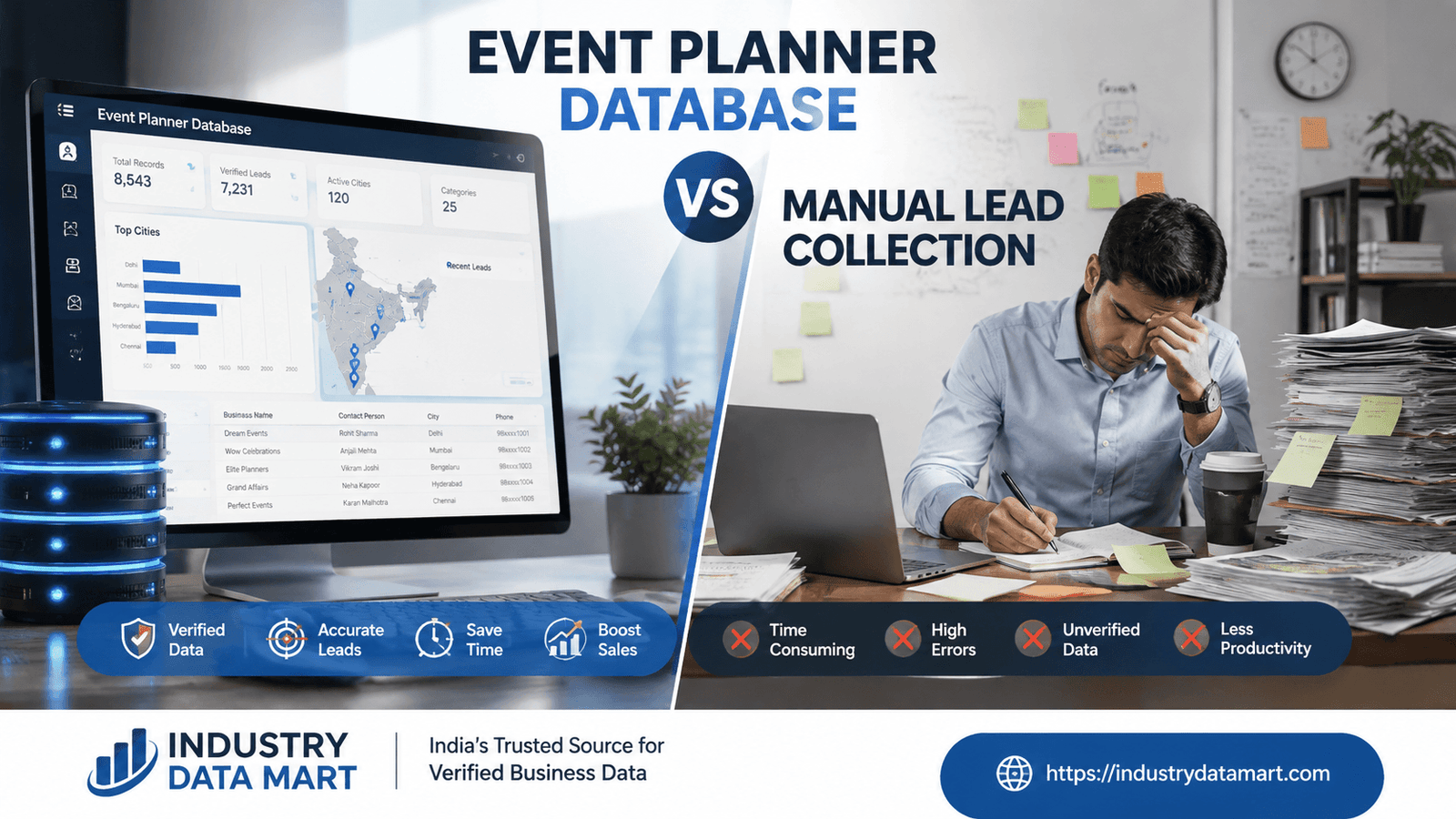
Finding the right event planners can make a major difference for businesses that supply event venues, catering, decoration, photography, sound systems, corporate gifts, transportation, or other event-related services. The real question is how you should find these prospects. Should your team spend hours searching for contacts manually, or should you use an Event Planner Database to build a focused prospecting pipeline? From a practical business and accounting perspective, the answer depends on your sales goals, team size, data requirements, and the value of your time.
Manual lead collection may appear inexpensive because there is no immediate database purchase involved. However, the hidden costs can be significant. Employees spend time searching websites, checking business listings, calling companies, recording information in spreadsheets, and removing duplicate or outdated records. An organised database can reduce much of this repetitive work and allow your sales team to focus on what actually generates revenue: contacting prospects and building relationships.
An Event Planner Database is a structured collection of business information related to event planners and event management professionals. Depending on the source and purpose, it can contain details such as business names, contact numbers, locations, business categories, and other useful information for sales prospecting.
For a company selling services to event planners, having organised information is more useful than simply having a large number of random contacts. The objective should be to identify relevant prospects and reach them with a clear business proposition.
For example, suppose a corporate gifting company wants to expand its business in Delhi, Noida, Lucknow, and Jaipur. Instead of asking its sales staff to search Google for event planners every morning, the company can start with a structured prospect list and divide it according to location or business category.
That approach creates a more systematic sales process.
Manual lead collection generally involves researching potential customers one by one. A salesperson may search business directories, social media platforms, websites, local listings, and search engines to identify event planners.
The process usually looks like this:
This method can work for a small number of prospects. If a salesperson needs 20 highly targeted contacts for a specific campaign, manual research may be reasonable.
The problem starts when the business needs hundreds or thousands of prospects. At that stage, manual research becomes a time-consuming operational activity rather than a productive sales function.
The biggest difference is time efficiency.
With manual research, employees repeatedly perform the same data collection activities. With an Event Planner Database, the initial information is already structured, allowing the sales team to spend more time on prospect qualification and communication.
Consider a simple example. If an employee spends five minutes researching and recording one prospect, collecting 500 prospects would theoretically require more than 41 hours of research. This does not include time spent correcting mistakes, removing duplicates, or verifying information.
A database can significantly reduce this initial research burden.
For any business, employee time has a financial value. A salesperson earning a salary should ideally spend most of their working hours selling, following up, negotiating, and managing customers.
If that person spends several hours every week collecting basic contact information, the company is effectively paying salespeople to perform administrative research.
This is particularly important for small businesses where one person may handle sales, customer service, and business development.
Another common issue with manual lead collection is inconsistency.
One employee may record a company as "ABC Events", another may write "ABC Event Management", while another may enter a person's name instead of the business name. Phone numbers may be entered in different formats, locations may be incomplete, and duplicate records can easily appear.
A structured Event Planner Database provides a more organised starting point for sales activity.
Businesses often need a focused Event Planner Contact List rather than a general business directory. A targeted list can make segmentation easier.
For example, a company selling event decoration services could divide prospects based on:
This allows sales representatives to create more relevant conversations instead of approaching every prospect with the same message.
Having contact information is only one part of lead generation. Relevance and usability are equally important.
Event Planner Verified Leads can be particularly valuable when a business wants to reduce wasted sales efforts. Before contacting a prospect, a sales team should ideally assess whether the business fits its target customer profile.
For instance, a wedding photographer may have little reason to approach an event planner who specialises exclusively in large corporate conferences, while a corporate event production company may find that same planner highly relevant.
This is why businesses should not judge a database purely by its size. Data quality, relevance, location coverage, and suitability for the intended campaign are more meaningful factors.
An Event Planner Marketing Database can support a more organised business development strategy.
Imagine a company providing premium banquet furniture to event organisers. Instead of running a broad marketing campaign, it can identify event planners in selected cities and create a targeted outreach strategy.
The company could then:
This makes lead generation measurable.
From a financial management perspective, measurement is critical. A company should know how much it spends on acquiring leads and how much revenue those leads eventually generate.
A database is not automatically the best answer for every situation.
Manual research can be useful when:
For example, if you are launching a specialised service for event planners handling international exhibitions in one particular city, manual research can help you understand the market before building a larger prospecting list.
The best approach is often a combination of structured data and human verification.
Buying or obtaining a database is only the beginning. The real benefit comes from how the information is used.
First decide what type of event planner you want to target. Consider location, event type, company size, and the services your business provides.
Do not treat every contact equally. Divide your prospects into practical categories so your sales team can prioritise the most relevant opportunities.
Business information can change over time. Before making a major sales effort, check important prospect details and confirm that the business matches your target profile.
A database should not result in generic communication. Use the information to understand who you are approaching and why your service may be useful to them.
Measure calls, meetings, quotations, conversions, and revenue. This allows management to calculate the actual return from the lead-generation activity.
The answer should be based on total cost, not just purchase price.
Manual collection may have no obvious data acquisition cost, but employee salaries, research hours, duplicate work, verification time, and opportunity costs all contribute to the real expense.
A structured Event Planner Database may require an upfront investment, but it can reduce repetitive research and provide a ready starting point for prospecting.
For a growing business, saving even a few hours every week can become financially meaningful over an entire year.
An Event Planner Database is an organised collection of business information about event planners and event-related companies. It can help businesses identify relevant prospects for sales and business development activities.
For large-scale prospecting, a database can save considerable time compared with collecting every contact manually. However, businesses should still review and qualify prospects before starting important sales campaigns.
An Event Planner Contact List gives sales teams a structured starting point for identifying potential customers. Teams can segment prospects by location, business type, and other relevant criteria before beginning outreach.
Event Planner Verified Leads refer to prospect information that has undergone a verification or quality-checking process. Businesses should still perform their own checks because company information can change over time.
Yes. A targeted database can help businesses reduce broad, unfocused prospecting and concentrate their sales and marketing efforts on relevant event planning businesses.
Manual lead collection has its place, especially when a business needs a small and highly specialised group of prospects. But when the objective is consistent B2B prospecting at scale, an Event Planner Database can provide a more organised and time-efficient starting point.
The key is not simply to collect more contacts. The goal is to build a practical prospecting system where relevant businesses can be identified, prioritised, contacted, and followed up systematically.
At Industry Data Mart, we believe business data should support real commercial decisions rather than simply add numbers to a spreadsheet. If your company wants to reach event planners more efficiently, explore the available Event Planner Database solutions and use structured prospect information to build a stronger sales pipeline.
Start with the right prospects, verify important details, follow up consistently, and measure your results. That is how business data becomes a genuine growth tool.

Lorem ipsum dolor sit amet consectetur. Nec nunc pellentesque massa pretium. Quam sapien nec venenatis vivamus sed cras faucibus.