 B2B Data Strategies
 Aug 20, 2026
7 min read
Aug 20, 2026
7 min read
Learn how an Event Planner Marketing Database helps businesses improve B2B targeting, generate qualified leads, and build effective marketing campaigns.
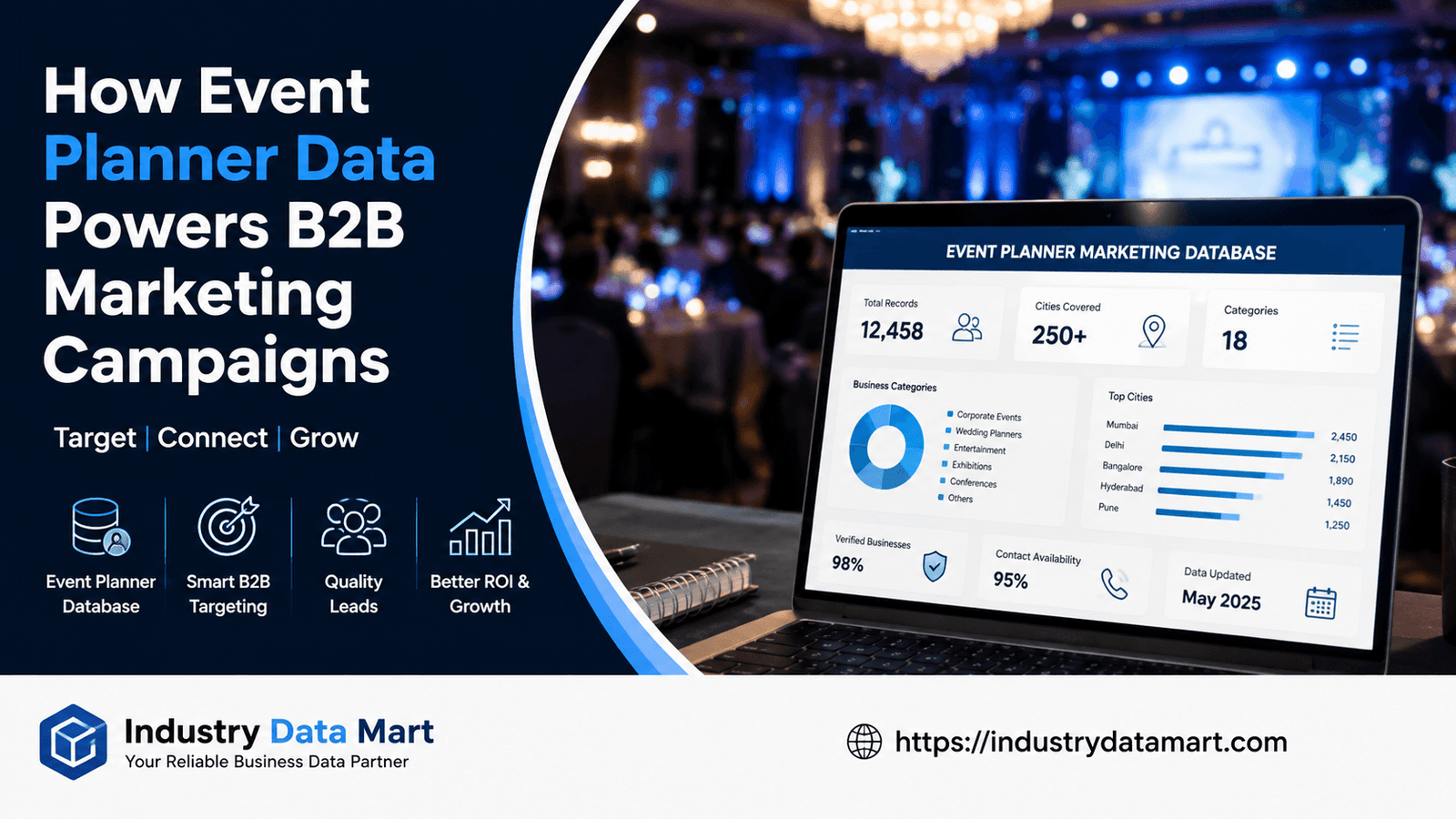
In B2B marketing, reaching the right business at the right time is often more important than reaching thousands of random prospects. For companies selling venues, catering services, decoration, printing, event technology, corporate gifting, transportation, or professional services, event planners can be valuable business prospects. An Event Planner Marketing Database helps businesses identify these prospects, understand their market, and create focused campaigns instead of spending money on unqualified audiences. For businesses looking for structured prospect information, an Event Planner Database can also make the process of identifying relevant businesses much more organised.
From our experience at Industry Data Mart, effective B2B marketing starts with good data. A business may have an excellent product, competitive pricing, and a strong sales team, but poor prospect data can make the entire campaign inefficient. A well-organised database helps sales and marketing teams focus their efforts on businesses that are more relevant to their products or services.
An Event Planner Marketing Database is a structured collection of business information related to event planners and event management companies. Depending on the source and purpose, the information may include business names, locations, contact numbers, business categories, and other useful details.
For B2B companies, this type of database can become a practical prospecting resource. Instead of searching for event planners manually across different platforms, a sales team can work with organised business data and segment prospects according to location, business type, or other available criteria.
The value is not simply in having a large number of records. The real benefit comes from having relevant information that supports better targeting and sales decisions.
Traditional marketing often involves showing the same message to a broad audience. B2B marketing works differently. Business buyers usually have specific requirements, budgets, timelines, and decision-making processes.
An Event Planner Marketing Database allows businesses to narrow their target audience and build campaigns around the actual needs of event professionals.
For example, a company selling event lighting equipment may want to approach event planners who regularly manage weddings, exhibitions, conferences, or corporate events. A general advertising campaign may reach thousands of unrelated people. A targeted database-based campaign can help the sales team concentrate on businesses that are more closely connected to the product.
This can improve campaign efficiency, reduce wasted sales effort, and make follow-ups more systematic.
Lead generation is one of the biggest challenges for B2B companies. Salespeople often spend significant time searching for prospects before they can even begin a conversation.
With Event Planner Lead Generation Data, businesses can create a more structured prospecting process.
The first step is identifying businesses that match your ideal customer profile. An event planner may need catering, printing, photography, transportation, event software, furniture, decoration, sound systems, or other business services.
A relevant Event Planner Marketing Database gives the sales team a starting point for identifying these potential customers.
Not every event planner has the same requirements. A business serving wedding planners may need a completely different approach from one selling services to corporate event organisers.
Companies can segment available Event Planner Database records according to factors such as:
This makes campaign messaging more relevant.
Geographical targeting is particularly useful for businesses that operate within specific service areas.
For example, a company providing event venue equipment in Delhi may not want its sales team spending most of its time contacting businesses outside its operating region. An Event Planner Business Database India can help businesses organise prospects geographically and develop territory-specific campaigns.
A company can create separate sales approaches for Delhi, Mumbai, Bengaluru, Hyderabad, Lucknow, Jaipur, or other markets based on its business strategy.
Personalisation does not always mean creating a completely different campaign for every prospect. It can simply mean making the message relevant to the prospect's business.
Suppose a company sells corporate event management software. Its message to a conference organiser should focus on attendee management, scheduling, registrations, and reporting. On the other hand, a company targeting wedding planners may focus on vendor coordination, customer communication, and event scheduling.
A properly segmented Event Planner Marketing Database makes these differences easier to manage.
The marketing team can prepare different campaign messages for different segments rather than sending one generic sales pitch to everyone.
Generating a lead is only the beginning. Consistent follow-up is where many B2B campaigns succeed or fail.
Sales teams can use an Event Planner Marketing Database to create structured follow-up lists. Prospects can be assigned to sales representatives based on territory or business category. Teams can also record conversations, requirements, quotations, follow-up dates, and sales outcomes in their CRM.
A simple process can look like this:
This approach transforms raw Event Planner Lead Generation Data into an organised sales process.
Using data for marketing is not enough. Businesses should also measure what happens after the campaign starts.
Important metrics may include:
For example, suppose a company contacts 500 relevant event planner businesses and receives 60 enquiries. If 15 become customers, the company can compare the campaign cost with the revenue generated.
This type of analysis helps management decide whether to expand the campaign, change the message, improve the target segment, or invest in another market.
Having business data does not automatically guarantee successful marketing. Businesses should avoid several common mistakes.
A large database may look attractive, but irrelevant records can increase sales workload without producing useful results. Businesses should focus on relevance, freshness, and suitability for their target market.
Different event businesses have different needs. A personalised and segmented approach is generally more useful than a generic sales message.
Businesses should use contact information responsibly and follow applicable Indian laws, regulations, and communication preferences. Marketing teams should also maintain proper internal processes for handling business information.
Business information can change. Companies may relocate, change their services, close operations, or update their contact details. Regular data verification and CRM updates are therefore important.
India's event industry covers weddings, exhibitions, conferences, product launches, entertainment events, corporate meetings, trade shows, and private functions. This creates opportunities for many B2B suppliers.
An Event Planner Business Database India can be useful for companies that want to expand their sales coverage across different cities and states. Instead of depending entirely on referrals or random online searches, businesses can create a more systematic prospecting strategy.
For example, a printing company could identify event planners in multiple cities and introduce its event branding services. A corporate gifting company could approach planners handling business conferences and employee events. Similarly, a technology provider could target organisers who may benefit from registration, ticketing, or event management solutions.
The key is matching the right product with the right business segment.
From a practical business perspective, data should be treated as a sales asset rather than simply a spreadsheet.
Before launching a campaign, clearly define your ideal customer. Decide which locations, event categories, and business types are most relevant. Then segment your Event Planner Marketing Database accordingly.
Start with a manageable campaign, measure the response, and improve your approach based on actual results. If one segment produces stronger enquiries, allocate more sales resources to that segment.
Also remember that database marketing works best when combined with a strong offer, professional communication, timely follow-ups, and proper CRM management. Good data opens the door, but your sales process determines what happens next.
An Event Planner Marketing Database is a structured collection of business information about event planners and event management companies. It can help B2B businesses identify relevant prospects, segment markets, plan sales campaigns, and improve their prospecting process.
It helps sales teams identify potential event planner businesses instead of spending excessive time searching for prospects manually. Businesses can segment prospects by location and other available characteristics and then create targeted sales campaigns.
Companies offering event-related products or services can benefit. Examples include caterers, event venues, printers, decorators, technology providers, transportation companies, corporate gifting suppliers, photographers, and other B2B service providers.
Yes. Businesses planning expansion across Indian cities and states can use structured prospect data to identify potential customers in different markets. This can support territory planning and help sales teams organise their outreach more efficiently.
Businesses should consider relevance, accuracy, freshness, coverage, and suitability for their target audience. A smaller, relevant dataset can often be more useful than a large collection of outdated or unrelated records.
A well-planned Event Planner Marketing Database can give B2B companies a practical advantage by making prospect identification, market segmentation, lead generation, and sales follow-up more organised. However, the database should be viewed as one part of a broader marketing strategy. Success also depends on the quality of the offer, communication, follow-up, sales process, and measurement.
At Industry Data Mart, we believe that better business decisions begin with better information. If your company wants to reach event planners more systematically, build focused campaigns, and improve its B2B prospecting process, the right Event Planner Marketing Database can be a valuable starting point. Use relevant data strategically, combine it with disciplined sales execution, and turn potential business opportunities into measurable growth.

Lorem ipsum dolor sit amet consectetur. Nec nunc pellentesque massa pretium. Quam sapien nec venenatis vivamus sed cras faucibus.