 B2B Data Strategies
 Sep 02, 2026
6 min read
Sep 02, 2026
6 min read
Learn how to maximise ROI using an Event Planner Contact List with smart targeting, segmentation, phone outreach, follow-ups, and measurable marketing strategies.
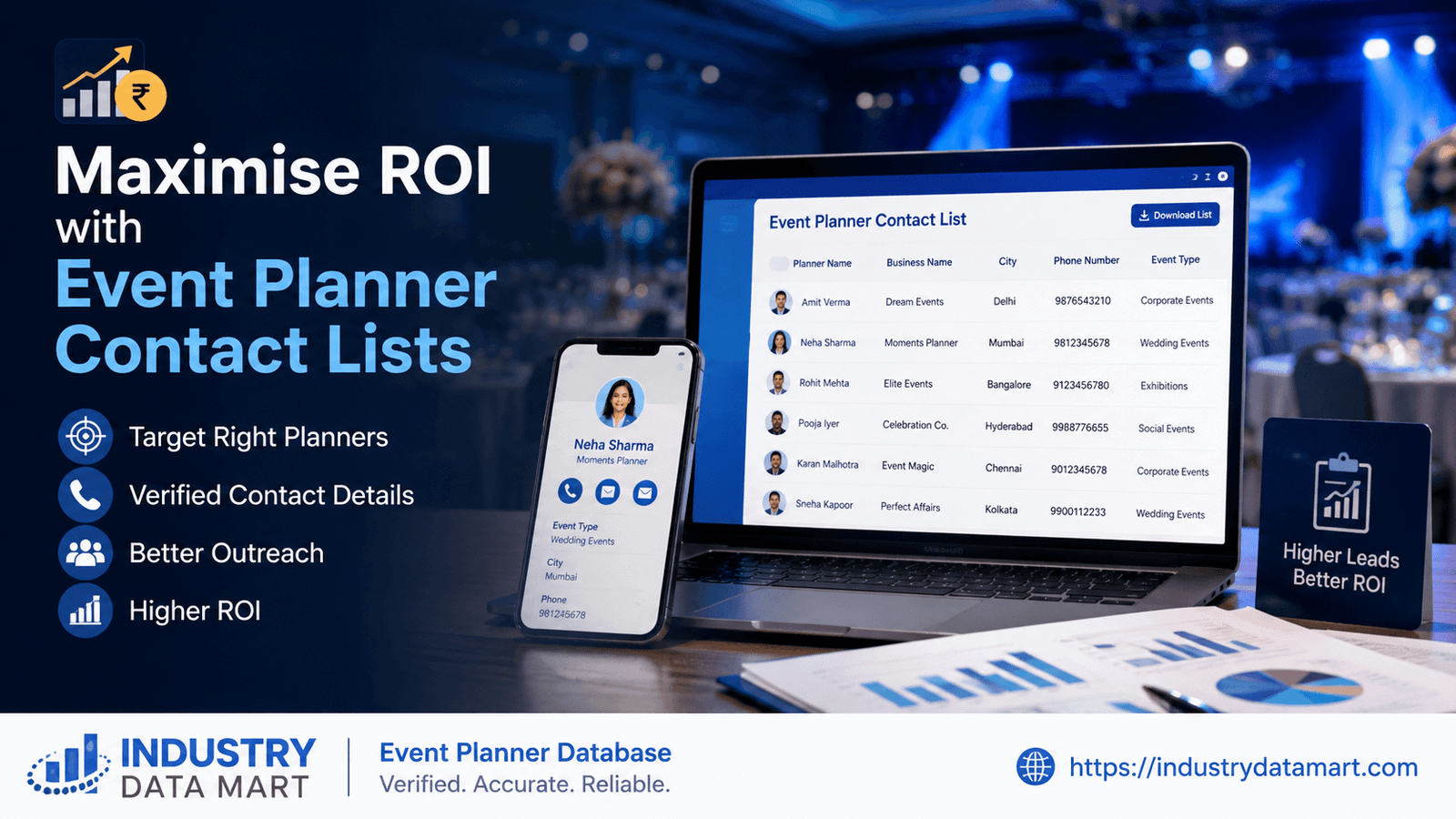
An Event Planner Contact List can become a powerful business development asset when it is used with the right strategy. Whether you sell catering services, venues, decoration, photography, transportation, printing, entertainment, corporate gifts, or event technology, event planners can introduce your business to a steady stream of commercial opportunities. However, simply purchasing or collecting contact information is not enough. The real value comes from knowing how to identify the right prospects, approach them professionally, and measure the results.
For businesses looking to build a reliable prospecting pipeline, a well-structured Event Planner Database can make the process more organised and efficient. Instead of spending hours searching for individual planners, sales teams can focus their time on qualified prospects and meaningful conversations.
From a practical business and accounting perspective, this is where ROI becomes important. Every marketing activity should ultimately be evaluated against the money and time invested. An Event Planner Contact List can deliver strong returns when it is treated as a sales tool rather than simply a collection of names and numbers.
Event planners regularly work with multiple vendors and service providers. A single planner may organise weddings, conferences, exhibitions, product launches, private celebrations, or corporate events throughout the year.
This creates an opportunity for businesses that can offer dependable products or services.
For example, suppose a printing company spends ₹25,000 on a targeted campaign aimed at event planners. If that campaign generates five customers, and each customer produces an average contribution of ₹15,000, the campaign generates ₹75,000 in contribution. The business can then compare the ₹75,000 return with the ₹25,000 marketing investment.
The lesson is simple: targeted outreach can be more valuable than broad advertising when your audience is clearly defined.
Before contacting prospects, identify exactly who you want to reach.
Not every event planner will be suitable for your business. A company providing corporate event technology, for example, may receive better results from planners handling conferences and exhibitions than from planners focused entirely on small private functions.
Consider factors such as:
The more clearly you define your ideal customer, the less money you waste contacting unsuitable prospects.
A large database does not automatically produce better results. Segmentation is what makes the data useful.
Divide your Event Planner Database into meaningful groups based on location, event type, business profile, or potential value.
For example, an event supplier operating in Delhi NCR could create separate prospect segments for corporate planners, wedding planners, exhibition organisers, and conference specialists.
This allows you to create a different sales approach for each group.
Instead of sending the same generic message to everyone, you can explain why your service is relevant to the specific events they organise.
Phone-based prospecting can be particularly useful when your objective is to start a business conversation quickly. An Event Planner Database with Phone Numbers allows sales teams to make direct contact rather than relying entirely on passive advertising.
However, calling should not mean making random sales pitches.
A professional call should be short and relevant. Introduce yourself, explain why you are calling, and ask whether the planner currently works with suppliers in your category.
For example:
“Hello, I’m calling from a company that provides event branding and printing services. We work with event professionals in this region and wanted to understand whether you currently outsource these requirements.”
This approach creates a conversation instead of immediately pushing a product.
Your prospecting system should become more useful over time. This is where an Event Planner Marketing Database can provide additional value.
Record useful sales information such as:
Maintaining these details helps your sales team understand what is happening with every prospect.
From a financial management perspective, this also makes campaign evaluation easier because you can connect marketing expenditure with enquiries, quotations, conversions, and revenue.
Not every contact deserves the same amount of sales effort.
Create a simple lead-scoring system. For instance, classify prospects as:
High priority: Regular event activity and strong requirement for your service.
Medium priority: Relevant business but uncertain purchasing frequency.
Low priority: Limited requirement or little evidence of current demand.
Your sales team can spend more time on high-potential prospects while maintaining lighter follow-up for other contacts.
This improves productivity and helps reduce the cost of acquiring customers.
One of the biggest mistakes businesses make is contacting a prospect once and then abandoning the opportunity.
Event planners are often busy managing clients, vendors, schedules, budgets, and last-minute changes. A prospect may not respond simply because the timing is inconvenient.
A structured follow-up process can include:
Follow-ups should always provide a reason to reconnect. Avoid repeatedly sending the same sales message.
A professional marketing strategy should be measurable.
Track metrics such as:
A basic ROI calculation can be expressed as:
ROI = (Return from Campaign − Marketing Cost) ÷ Marketing Cost × 100
Suppose you invest ₹40,000 in database acquisition and sales outreach and generate ₹1,20,000 in attributable gross profit.
Your ROI would be:
(₹1,20,000 − ₹40,000) ÷ ₹40,000 × 100 = 200%
This gives management a much clearer picture of whether the campaign is financially worthwhile.
Buying a huge number of contacts may look attractive, but a smaller, relevant database can sometimes generate better commercial results.
Data should be as accurate and relevant as possible. Businesses should also follow applicable privacy, telecommunications, and marketing regulations when contacting prospects.
Your objective should be to build a useful prospect pool that supports genuine business conversations.
Quality data combined with disciplined sales execution is generally more valuable than a large but poorly targeted list.
Even a good Event Planner Contact List can produce disappointing results if it is poorly managed.
Common mistakes include:
The solution is to connect your database, sales process, and financial measurement into one system.
An Event Planner Contact List is a structured collection of business contact information related to event planning professionals. Businesses can use it to identify relevant prospects for services such as catering, venues, printing, decoration, transportation, photography, technology, and event supplies.
It can help businesses reach a clearly defined professional audience instead of spending resources on broad and less targeted marketing. Better targeting can improve sales productivity, generate more qualified conversations, and potentially reduce customer acquisition costs.
Yes, when used responsibly and with an appropriate sales strategy. Phone numbers can support direct business conversations, qualification, follow-ups, and relationship development. The quality and relevance of the underlying data remain important factors.
Businesses should track the cost of acquiring and using the data against measurable outcomes such as qualified leads, quotations, customers, revenue, and gross profit. Looking only at the number of calls or leads can give an incomplete picture of campaign performance.
No. Relevance and data quality are often more important than database size. A smaller group of well-targeted prospects can produce stronger results than thousands of contacts who have little connection with your products or services.
An Event Planner Contact List should not be viewed as just a list of phone numbers or business information. When properly segmented, managed, followed up, and measured, it can become an important part of a B2B sales strategy.
The key is to start with the right prospects, personalise your outreach, maintain consistent follow-ups, and calculate the financial results. Businesses should continuously compare marketing costs with qualified leads, customer acquisition, revenue, and profitability.
If your business wants to reach event professionals more efficiently, Industry Data Mart can help you build a targeted prospecting strategy around relevant business data. Explore suitable event planner business data, organise your outreach, and turn your Event Planner Contact List into a measurable source of new business opportunities.

Lorem ipsum dolor sit amet consectetur. Nec nunc pellentesque massa pretium. Quam sapien nec venenatis vivamus sed cras faucibus.