 Healthcare Industry Data
 Aug 25, 2026
5 min read
Aug 25, 2026
5 min read
Discover the top industries using Dental Clinic Database in India to find verified prospects, improve sales outreach, and build stronger B2B opportunities.
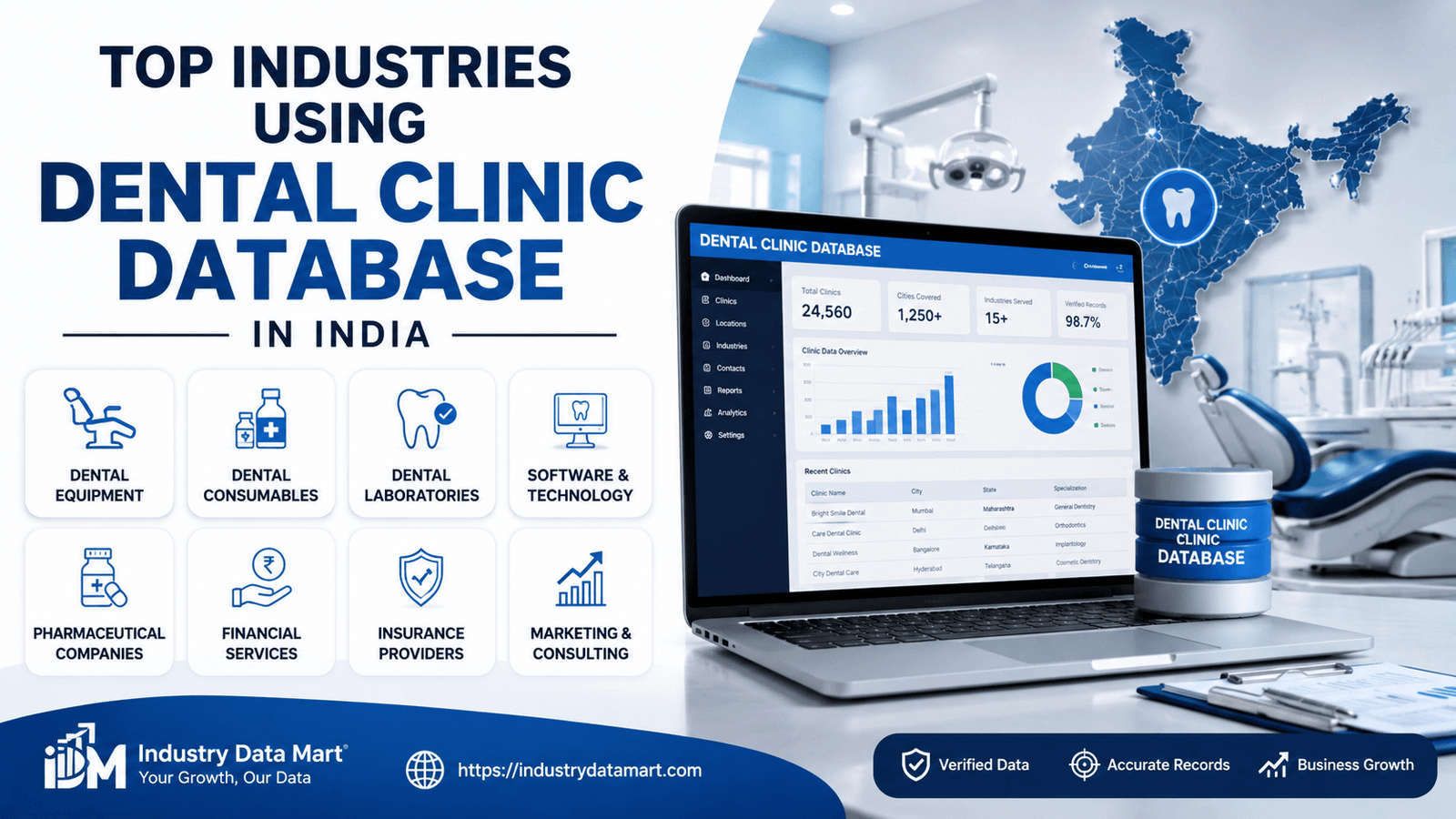
The dental healthcare sector in India is expanding rapidly, creating business opportunities not only for dentists but also for companies that supply products, technology, services, and financial solutions to clinics. A reliable Dental Clinic Database can help businesses identify relevant clinics, understand their market, and connect with potential customers more efficiently. For businesses looking to explore this market, Dental Clinic Database can provide a structured starting point for identifying dental clinics and related business prospects across India.
From dental equipment manufacturers to software companies, laboratories, pharmaceutical businesses, and financial service providers, several industries depend on accurate clinic information for business development. The real value is not simply having a list of names. It is about having useful business information that supports better targeting, sales planning, territory expansion, and relationship building.
Dental clinics purchase a wide range of products and services throughout their operations. A newly opened clinic may need dental chairs, imaging equipment, instruments, software, furniture, laboratory services, and financial support. Established clinics may regularly upgrade equipment, purchase consumables, adopt new technology, or expand into additional locations.
For suppliers, manually finding individual clinics can consume considerable time. A properly structured Dental Clinic Business Database India resource allows companies to organize prospects according to location, business type, and other relevant criteria.
For example, a dental equipment distributor operating in Maharashtra may want to concentrate its sales team on clinics in Mumbai, Pune, Nashik, and nearby commercial areas. Instead of approaching businesses randomly, a structured database can support a more focused sales strategy.
Dental equipment is one of the most obvious sectors benefiting from clinic data. Manufacturers and distributors supply dental chairs, X-ray systems, sterilization equipment, compressors, suction systems, intraoral scanners, and other professional equipment.
A sales team can use clinic information to identify potential buyers and prioritize prospects based on their business location and requirements.
For instance, a company launching a new digital dental scanner may want to approach multi-chair clinics, dental hospitals, and practices that are investing in modern technology. Targeted prospecting can make the sales process more efficient than broad, untargeted promotion.
Dental clinics continuously require consumable products. Gloves, masks, impression materials, bonding agents, composites, disinfectants, burs, dental needles, and other supplies need regular replenishment.
This makes dental consumables a recurring B2B market.
Suppliers can use a Dental Clinic Database to develop territory-wise sales plans and help field representatives identify clinics that may be suitable prospects. Regular follow-ups can also help suppliers build long-term commercial relationships instead of relying only on one-time transactions.
Dental laboratories work closely with dentists and clinics for crowns, bridges, dentures, aligners, implants, and other laboratory-based services.
A laboratory expanding into a new city needs access to dental practices that could become referral or business partners. This is where a Dental Clinic Sales Leads Database can become useful.
For example, a laboratory based in Delhi may want to expand its client network into Noida, Ghaziabad, Gurgaon, or other nearby markets. Instead of waiting for referrals, its sales team can proactively identify dental clinics and introduce its services.
Pharmaceutical and healthcare companies also have commercial relationships with dental professionals. Products related to oral care, pain management, infection control, and dental procedures may be promoted through professional channels.
However, successful B2B outreach requires proper segmentation. A company should understand whether it is targeting a single-doctor practice, a multi-specialty dental clinic, or a larger dental healthcare organization.
A structured database can support this segmentation and help sales representatives plan their outreach more systematically.
Technology has become an important part of modern dental practice. Clinics increasingly use appointment management systems, billing software, patient management platforms, digital imaging solutions, inventory systems, and other technology tools.
Software companies can use clinic data to identify businesses that may be potential customers for these solutions.
A practical approach is to divide prospects into categories such as independent clinics, dental hospitals, clinic chains, and specialty practices. Each category can then receive a different sales pitch based on its likely operational requirements.
The market extends beyond traditional dental suppliers. Several supporting industries can also use verified business information for targeted B2B development.
These include:
For these businesses, the objective is generally the same: identify relevant clinics, reach the right decision-makers, and develop meaningful commercial relationships.
The quality of business data matters as much as the size of the database. Outdated or inaccurate records can result in wasted calls, incorrect targeting, and inefficient sales activity.
Businesses looking for Dental Clinic Verified Leads India should therefore pay attention to data quality and relevance.
A practical lead-generation process can include the following steps:
This process turns business data into an actual sales asset rather than treating a database simply as a collection of contact records.
The usefulness of a database depends on the information available and how accurately it represents the target market. Depending on the source and package, businesses may look for information such as:
Companies should always check the source, freshness, coverage, and applicable data-use requirements before incorporating business information into their sales process.
A small supplier and a large healthcare manufacturer may use the same type of business data differently.
A small distributor may focus on a few cities and use the information to create a local calling list. A national manufacturer may divide prospects across regional sales teams and create separate strategies for North, South, East, and West India.
Similarly, a startup selling dental practice management software may use clinic data to identify early adopters, while an established company may use it for geographic expansion.
The important point is to match the database with a clearly defined business objective.
From a business and financial planning perspective, companies should evaluate the expected return before purchasing any database.
Consider three basic questions:
Who are you trying to reach?
Clearly define your ideal customer before selecting data.
What will you offer them?
A database is useful only when the business has a relevant product or service.
How will you measure the result?
Track the number of meaningful conversations, qualified opportunities, meetings, and conversions.
For example, if a company invests ₹50,000 in a lead-generation campaign, it should not judge the campaign only by the number of calls made. Management should calculate the cost per qualified prospect and ultimately compare the investment with the revenue generated.
This approach helps businesses make better decisions about future sales and marketing budgets.
A Dental Clinic Database is a structured collection of business information related to dental clinics and practices. Businesses can use such information for market research, sales prospecting, territory planning, and B2B relationship development, subject to applicable privacy, communication, and data-use requirements.
Dental equipment suppliers, consumables distributors, laboratories, pharmaceutical companies, healthcare technology providers, financial service companies, insurance businesses, furniture suppliers, consultants, and healthcare service providers can use dental clinic business data for legitimate B2B activities.
It can help sales teams organize prospects by geography and business category, reduce manual prospect research, prioritize suitable accounts, and plan more structured outreach. The actual results depend on data quality, sales execution, product-market fit, and the company's follow-up process.
Yes. Accurate and relevant business information can reduce wasted sales effort and improve prospect targeting. Companies should evaluate the source, freshness, accuracy, coverage, and permitted use of the information before using it commercially.
Businesses should first identify their target locations and customer profile. They should then evaluate data fields, geographic coverage, verification practices, freshness, and suitability for their intended B2B activity rather than choosing a database solely on the number of records.
The Indian dental healthcare market offers opportunities for many supporting industries, from equipment manufacturers and laboratories to software companies, financial service providers, and healthcare consultants. A well-organized Dental Clinic Database can help these businesses identify relevant prospects, build territory-wise sales strategies, and improve the efficiency of their B2B development efforts.
At Industry Data Mart, the focus should not simply be on providing business information. The real objective is to help businesses use structured market data more intelligently. Before investing in any database, define your target customer, verify that the information suits your business objective, and build a measurable sales process around it.
If your company is planning to expand its presence in the dental healthcare market, Industry Data Mart can be a practical resource for researching prospects and

Lorem ipsum dolor sit amet consectetur. Nec nunc pellentesque massa pretium. Quam sapien nec venenatis vivamus sed cras faucibus.