 Healthcare Industry Data
 Aug 17, 2026
5 min read
Aug 17, 2026
5 min read
Discover how a Dental Clinic Database helps medical suppliers find qualified buyers, improve sales outreach, expand market reach, and grow revenue in India.
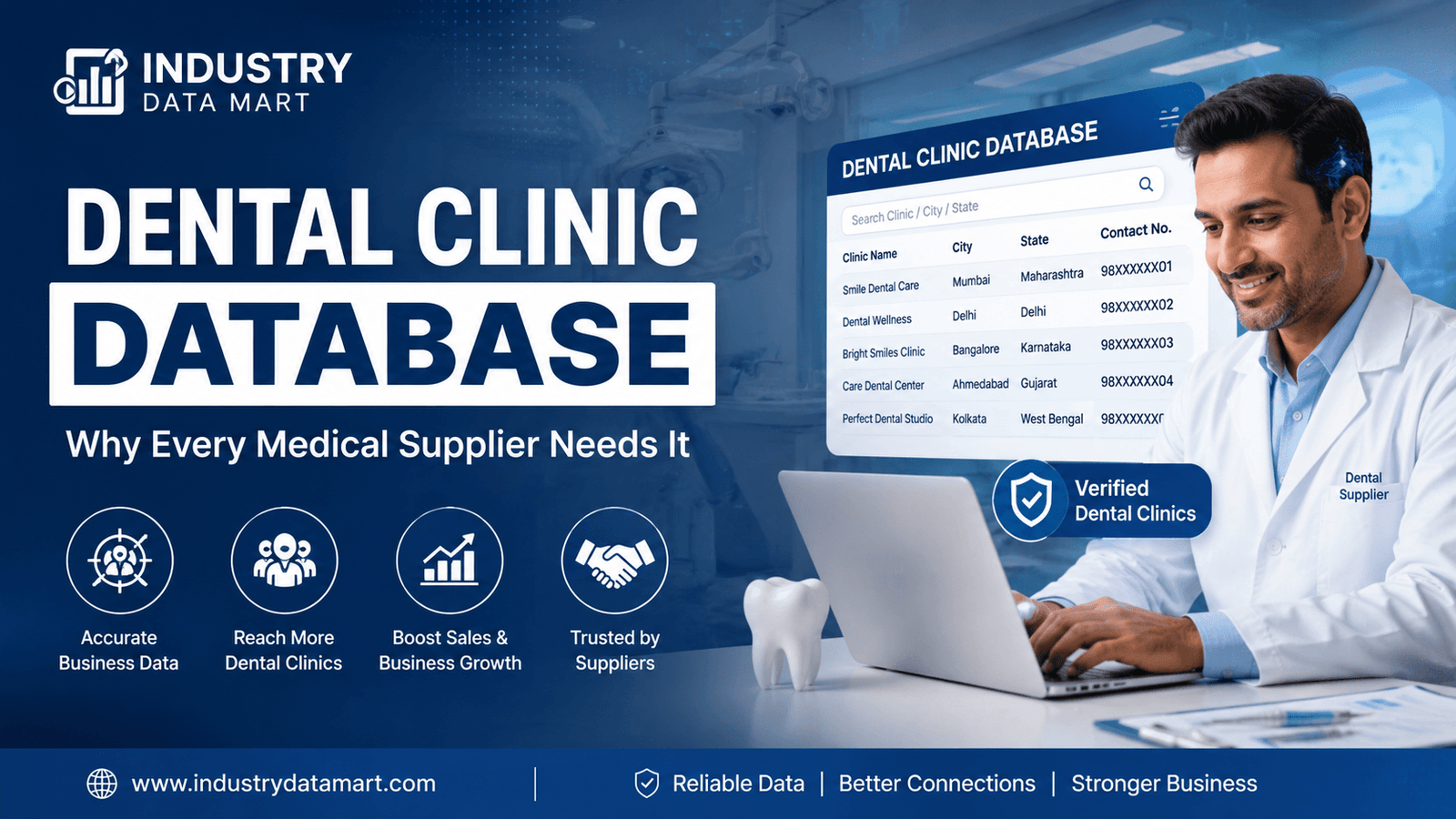
For a medical supplier, having good products is only half the business. The bigger question is: are you reaching the right buyers at the right time? Dental clinics purchase a wide range of products, including dental instruments, consumables, diagnostic equipment, sterilisation supplies, furniture, and other healthcare essentials. This makes dental clinics an important customer segment for distributors and manufacturers. A reliable Dental Clinic Database can help suppliers identify potential customers, organise their sales efforts, and build a more predictable business pipeline.
From a practical business perspective, data is now one of the most useful assets for a growing medical supply company. Instead of depending entirely on referrals or random calling, suppliers can use structured business information to identify dental clinics across cities and states. At Industry Data Mart, we believe that the right database can make sales planning more organised, measurable, and cost-effective.
Dental clinics are recurring buyers. Unlike customers who purchase a medical product only once, clinics regularly need replacement instruments, consumables, equipment servicing, protective products, and other supplies. Therefore, building a systematic approach to reaching dental practices can create opportunities for repeat business.
A Dental Clinic Database gives a supplier a practical starting point. Instead of spending hours searching for clinics individually, the sales team can work with organised information and focus on qualified prospects.
For example, imagine a dental equipment distributor operating in Uttar Pradesh. The company wants to introduce a new dental chair. Calling hundreds of unrelated healthcare businesses would waste time. With a Dental Clinic Database, the distributor can identify dental clinics as the relevant prospect group and plan its outreach according to location and business requirements.
One of the biggest advantages of organised data is better sales planning. Medical suppliers often have limited sales staff and budgets. Every sales call, visit, and follow-up therefore needs to have a clear purpose.
Dental Clinic Marketing Leads India can help businesses develop a targeted prospecting strategy rather than relying on broad advertising alone. Suppliers can divide their prospects geographically and assign specific areas to sales representatives.
For instance, a supplier may create separate sales territories for:
This approach makes it easier to measure the number of prospects contacted, appointments generated, quotations sent, and conversions achieved.
A good Dental Clinic Database also supports territory expansion. If a supplier has strong sales in one city, the company can use similar data to explore nearby markets instead of starting the research process from zero.
Salespeople need accurate and usable information. A Dental Clinic Contact Details List can make prospecting more structured by giving representatives access to relevant business contact information.
Consider a medical distributor launching a new range of dental consumables. Without organised data, the salesperson may spend several hours searching Google, social media pages, directories, and local references. Even after that effort, the information may be incomplete or outdated.
With a properly structured Dental Clinic Database, the sales team can spend more time on selling and less time on manual research.
The information can also help sales managers create simple workflows:
This process turns raw business information into a practical sales system.
India has a large and diverse healthcare market, and dental services are an important part of it. A supplier that wants to expand nationally cannot depend only on existing customers.
A Dental Clinic Business Database India can support expansion by helping businesses understand where potential customers are located. This can be particularly useful for manufacturers and distributors entering new states.
Suppose a company currently supplies dental products to clinics in Mumbai and Pune. Management wants to enter Bengaluru and Hyderabad. Before hiring a large sales team, the company can research the available clinic market and identify potential business prospects.
This reduces uncertainty during expansion.
A Dental Clinic Database is therefore not simply a list of businesses. When used correctly, it becomes a planning resource that can support decisions about sales territories, distribution, market entry, and customer acquisition.
Almost every business selling products or services to dental practices can benefit from targeted prospect data.
Manufacturers of dental chairs, X-ray systems, compressors, autoclaves, imaging equipment, and other machinery can identify clinics that may have equipment purchasing requirements.
Suppliers of gloves, masks, impression materials, disposable products, restorative materials, and other consumables can use organised prospects for regular sales outreach.
Companies supplying medicines, oral-care products, infection-control products, and healthcare essentials can use relevant clinic information to develop B2B sales opportunities.
Dental equipment servicing companies can also use a Dental Clinic Database to identify clinics that may require installation, maintenance, repairs, or annual servicing.
The usefulness of business data depends heavily on how well it is organised. Medical suppliers should look for information that supports actual sales activity rather than unnecessary details.
Important fields may include:
Before purchasing any database, suppliers should also understand how the data was collected, when it was last updated, and whether the information is relevant to their target market.
Buying data alone does not generate revenue. The real benefit comes from how the business uses it.
First, define your ideal customer. A supplier selling premium dental chairs may target established clinics rather than every dental practice.
Second, divide the prospects into manageable segments. Location, clinic type, product requirement, and sales territory can all be useful segmentation criteria.
Third, prepare a professional sales approach. Avoid making every interaction sound like a generic sales pitch. A supplier should explain the specific problem its product solves.
Fourth, maintain follow-ups. Many B2B purchases are not completed during the first conversation. A clinic may need approval, budget planning, comparison with another supplier, or time to discuss the purchase internally.
Finally, measure results. Track contacts, conversations, quotations, meetings, conversions, and revenue generated from each campaign. This helps management understand whether the sales strategy is actually producing a return.
A Dental Clinic Database should be treated as a business resource, not a shortcut to instant sales.
One common mistake is contacting every prospect with exactly the same message. Different clinics have different purchasing needs.
Another mistake is failing to verify important information before making a high-value sales decision. Business information can change, so suppliers should use reasonable verification procedures before relying on a prospect for a major commercial activity.
Ignoring follow-ups is another major problem. A prospect who does not buy today may become a customer next month.
Suppliers should also respect applicable laws and professional communication standards when contacting businesses. Good data should support responsible selling, not indiscriminate communication.
A Dental Clinic Database helps suppliers identify relevant dental businesses in their target markets. It can reduce manual prospect research, improve territory planning, and provide a structured foundation for B2B sales activities.
Yes. Suppliers can use location-based business information to identify potential dental clinics in new cities and states. This can make market research and sales territory planning more organised.
Dental Clinic Marketing Leads India refers to business prospect information related to dental clinics across Indian markets. Suppliers can use such information to identify potential B2B customers and organise their sales outreach.
A Dental Clinic Contact Details List can help sales representatives identify relevant businesses and organise their prospecting activities. It can be particularly useful for distributors, manufacturers, and service providers targeting dental practices.
Suppliers should consider data relevance, coverage, available business fields, freshness, usability, and the credibility of the data provider. The database should match the company's target geography and customer profile.
For medical suppliers, reaching the right customer is often more valuable than simply reaching more customers. A well-organised Dental Clinic Database can help businesses identify relevant prospects, plan territories, improve sales productivity, and explore new markets across India.
Whether you manufacture dental equipment, distribute consumables, supply healthcare products, or provide technical services, targeted business data can give your sales team a more structured starting point.
Industry Data Mart helps businesses make prospecting more focused by providing business data designed for B2B sales and market research. If your goal is to expand your customer base, enter new markets, and connect your sales team with relevant dental businesses, a professionally sourced Dental Clinic Database can be a practical addition to your growth strategy.

Lorem ipsum dolor sit amet consectetur. Nec nunc pellentesque massa pretium. Quam sapien nec venenatis vivamus sed cras faucibus.